
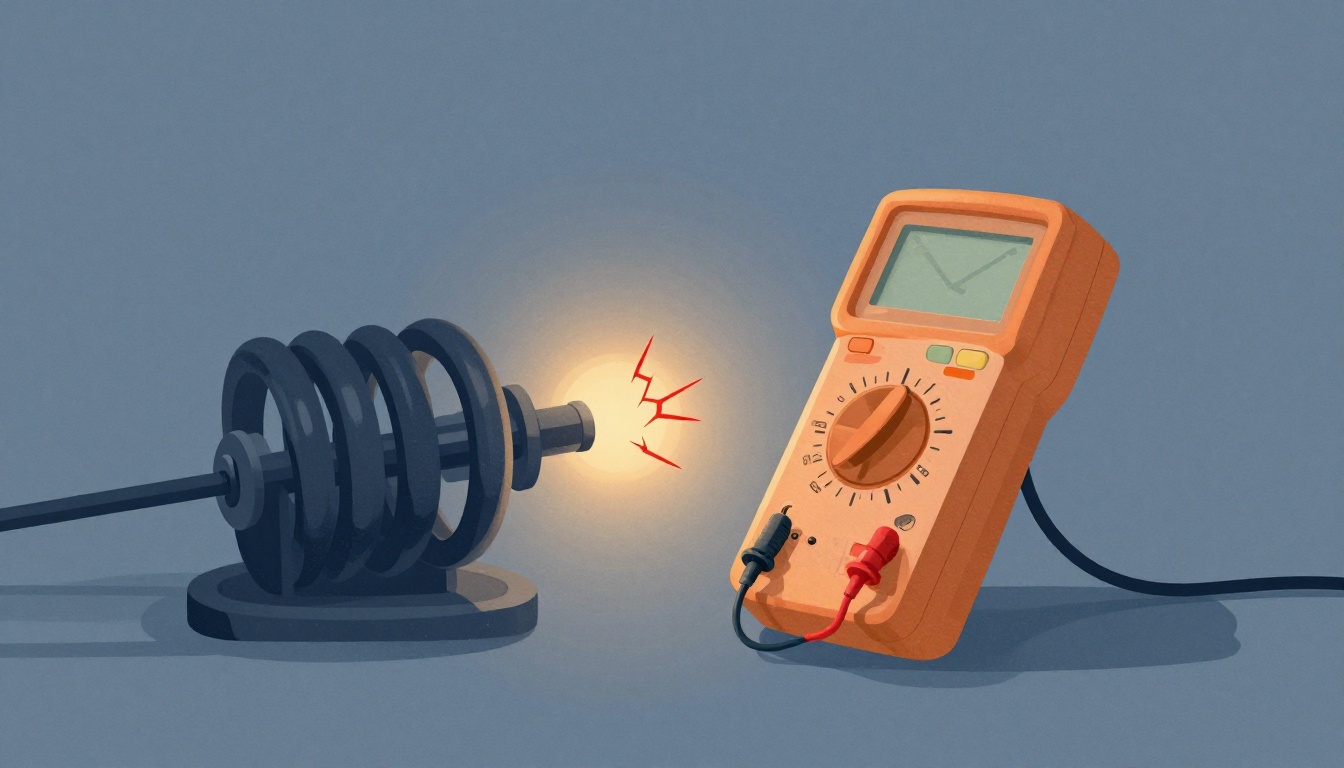
When a hydraulic function stops responding, a shorted solenoid coil is often the culprit. A coil that has failed due to shorted turns or a short to ground can cause erratic operation, blown fuses, or a completely dead circuit. Testing the coil with a multimeter is a straightforward process that can save you hours of downtime and prevent unnecessary part replacement. This guide walks you through the diagnostic steps, explains what the readings mean, and highlights critical safety precautions.
Which reading indicates a shorted solenoid coil?
Select one answer.
Understanding solenoid coil failures
A solenoid coil is a tightly wound copper wire that creates a magnetic field to move a plunger or spool, directing hydraulic fluid flow. When the coil's insulation breaks down, it can create a short circuit. There are two main types of shorts you'll encounter:
- Shorted turns: Adjacent windings touch, reducing the effective resistance and increasing current draw, which leads to overheating and burnout.
- Short to ground: The coil winding contacts the metal housing or frame, causing current to bypass the coil and potentially damaging the control circuit.
According to Fab Heavy Parts, a very low resistance (less than 1 ohm) suggests shorted turns inside the winding, which means the coil has failed. Additionally, Power & Motion Tech notes that accidental splashing or soaking of the coil's lead wire junctions can cause short circuits.
Step-by-step testing procedure
1. Safety first
Before testing, ensure the machine is powered off and the key is removed. Disconnect the electrical connector from the solenoid to isolate the coil. This prevents false readings and protects you from live circuits.
2. Measure coil resistance
Set your digital multimeter to the ohms (Ω) function. Place the multimeter leads on the two coil terminals. A healthy coil typically reads between 2 and 50 ohms, depending on the design. If the reading is very low (near 0 ohms), the coil is shorted and must be replaced. If the reading is infinite (OL), the coil is open and also faulty. Tameson recommends testing both resistance and voltage to diagnose the solenoid.
3. Check for short to ground
With the connector still unplugged, set your multimeter to ohms and place one lead on a coil terminal and the other on a clean chassis ground. The reading should be OL (open line). If you get a resistance reading, the coil is shorted to ground and needs replacement. This test is critical because a short to ground can pull down the control voltage and affect other circuits, as explained by a technician on AgTalk.
4. Verify voltage supply
Reconnect the connector and turn the machine on. Measure the voltage at the coil terminals. It should match the rated voltage (e.g., 12V or 24V). If voltage is present but the coil doesn't click, the coil is likely faulty. If voltage is absent, trace the wiring back to the control module.
Interpreting your readings
| Reading | Indication | Action |
|---|---|---|
| 0-1 ohm | Shorted turns | Replace coil |
| OL (infinite) | Open circuit | Replace coil |
| Normal (2-50 ohm) | Coil OK | Check other components |
| Resistance to ground | Short to ground | Replace coil |
Avoiding common testing mistakes
- Don't test with power applied: Always disconnect the coil before measuring resistance to avoid damaging the multimeter.
- Beware of polarity: Some DC solenoids have internal suppressor diodes. Connecting them with reversed polarity can short the diode and destroy the coil. Insane Hydraulics warns that a 24V coil can produce a 500V spike when switched off, and incorrect polarity can bypass the coil entirely.
- Check for mechanical issues: A stuck plunger can cause the coil to overheat and burn out. If the coil tests fine but the valve doesn't shift, manually depress the plunger to check for contamination or binding, as suggested by All World Machinery.
When to call a professional
If you've tested the coil and it's within spec, but the hydraulic function still fails, the problem may lie in the control module, wiring harness, or the valve itself. In such cases, professional diagnostics can save you time and money. A certified technician can perform advanced tests and repair or replace electronic controls without the need for full component replacement.
Quiz: Test your knowledge
Which reading indicates a shorted solenoid coil?
- A) 0.5 ohms
- B) 10 ohms
- C) OL (open line)
Correct answer: A) 0.5 ohms
How the Featured Expert Can Help
If you're facing persistent solenoid or hydraulic control issues, RE-CLICK offers electronic control repair and diagnostics for heavy equipment, including joysticks, ECUs, and sensors. Their certified technicians provide nationwide support, aiming to reduce downtime and extend equipment life. Call them for fast, reliable service.